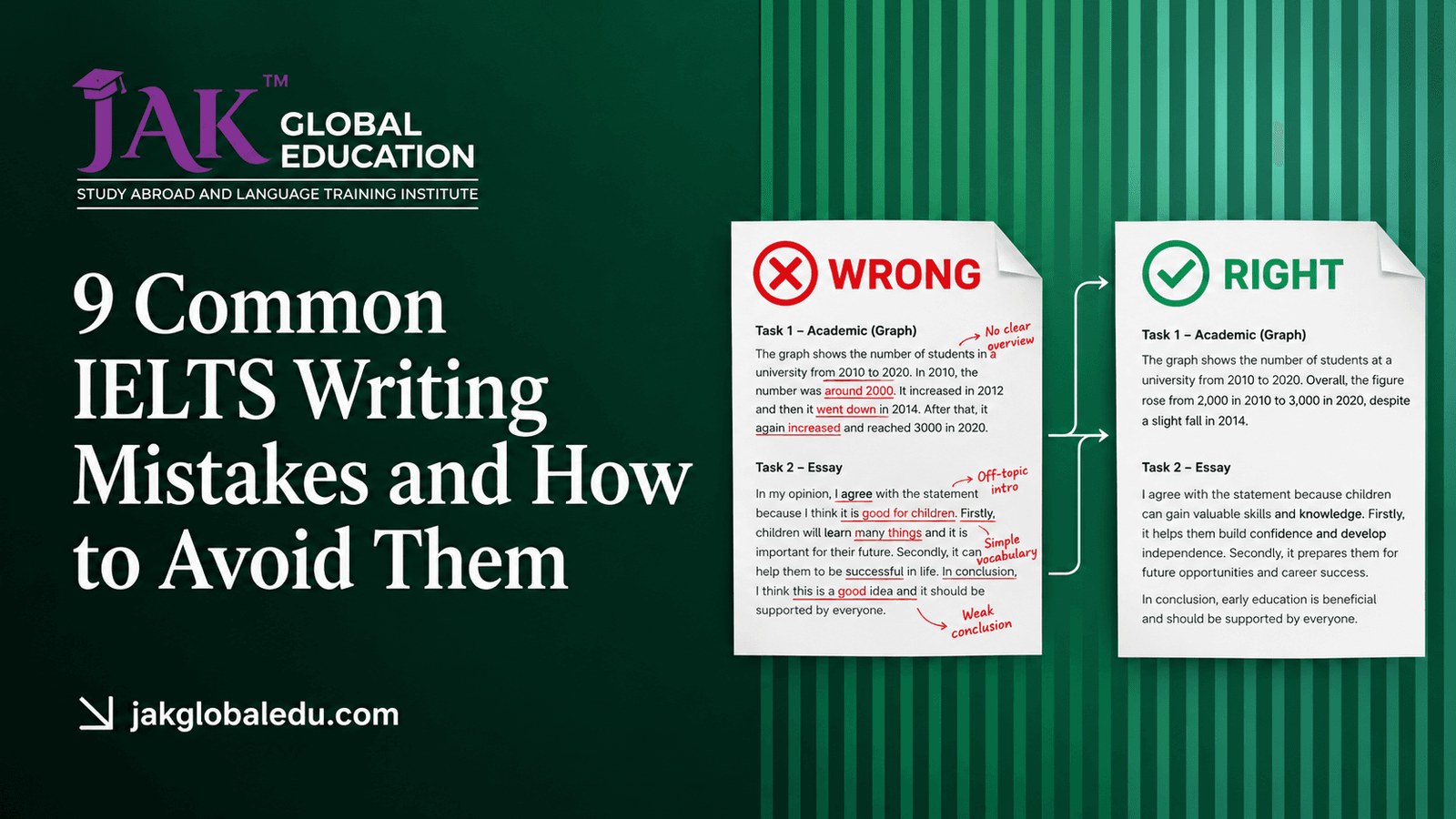
Many IELTS candidates have enough English for a strong Writing score but lose marks to avoidable habits. They skip part of the question, rely on memorised templates, or run out of time before the conclusion. Once you can name these habits, they are much easier to fix.
This guide explains nine common IELTS Writing mistakes across Task 1 and Task 2, for both Academic and General Training. Each one covers why it happens, how it affects your assessment, a before-and-after example, and what to do about it.
A note on sources: the marking criteria below come from the publicly available IELTS Writing band descriptors. The examples and tips are general preparation advice from JAK Global Education, not official IELTS rules.
What Are the Most Common IELTS Writing Mistakes?
The most common IELTS Writing mistakes are: not answering every part of the question, underdeveloped ideas, a Task 1 report with no overview, the wrong tone in General Training letters, memorised templates, mechanical linking, unnatural vocabulary, frequent grammar errors, and poor time management.
A common IELTS Writing mistake is a repeated habit that works against one of the four marking criteria. Examiners don’t mark “mistakes” as a list. They judge how well your response meets each criterion, so a single habit can affect more than one score.
Key Takeaway: Most Writing mistakes are habits, not gaps in English. Answer the whole question, support every idea, use language you control, and leave time to check your work.
Understanding the IELTS test format and duration can also help you plan your writing time more effectively. Read our guide to IELTS exam duration and timing for a complete overview.
How Is IELTS Writing Marked?
IELTS Writing is marked on four equally weighted criteria. Task 2 carries more weight than Task 1 in your final Writing band.
- Task Achievement (Task 1) or Task Response (Task 2): Did you answer the question fully, with relevant, developed ideas?
- Coherence and Cohesion: Is your writing organised in logical paragraphs, with ideas linked clearly?
- Lexical Resource: Is your vocabulary accurate, natural and varied enough for the task?
- Grammatical Range and Accuracy: Do you use a range of structures with good control?
You have 60 minutes for both tasks. Task 1 needs at least 150 words and Task 2 at least 250. A sensible split is about 20 minutes for Task 1 and 40 for Task 2.
9 Common IELTS Writing Mistakes (and How to Fix Them)
Mistake 1: Not Answering Every Part of the Question
What it is: Writing a well-structured essay that only answers part of the prompt, such as discussing one view when the question asks for both.
Why it happens: Candidates see a familiar topic and start writing before reading the instructions closely.
How it affects your score: This mainly affects Task Response. A fluent essay that misses part of the task can still be marked down for it.
Example question: Some people think university education should be free. Others believe students should contribute to the cost. Discuss both views and give your opinion.
- Weak: Three paragraphs on why free education helps society, with no discussion of student contributions and no clear opinion.
- Better: Paragraph 1 explains the case for free education. Paragraph 2 explains the case for shared costs. The introduction and conclusion state a clear opinion, such as: “While free tuition widens access, a modest contribution from students seems more sustainable.”
How to avoid it: Underline every instruction in the question and write a one-line plan that matches each one before you start.
Mistake 2: Stating Ideas Without Developing Them
What it is: Making a point but never explaining it, or giving no example or consequence.
Why it happens: Candidates worry about time and move on to the next idea too quickly. Others aren’t sure what “developing” an idea means.
How it affects your score: Thin paragraphs weaken Task Response, and they often make the essay feel disconnected, which affects Coherence and Cohesion.
- Weak: “Technology is useful. It helps people a lot. Many people use it every day.”
- Better: “Online banking apps let working parents pay bills outside office hours, which saves time that would otherwise be spent queuing at a branch.”
How to avoid it: Build each body paragraph as point, explanation, example. If a paragraph has a claim but no “because” or “for example”, it needs more.
Mistake 3: Writing Academic Task 1 Without a Clear Overview
What it is: Describing every number in a graph, chart, map or process without summarising the main pattern.
Why it happens: Data feels safe to copy. Candidates also confuse “detail” with “accuracy”.
How it affects your score: An overview is a key feature of a strong Task 1 response. Without it, Task Achievement usually suffers, and the report can read like a list.
Example task: A line graph shows the percentage of employees working from home in four age groups between 2010 and 2020.
- Weak: “In 2010, 8% of 25-34-year-olds worked from home. In 2015, it was 12%. In 2020, it was 30%.” The paragraph continues number by number with no summary.
- Better: “Overall, home working rose in every age group, with the steepest increase among employees aged 25-34.” Then support it with two or three key figures.
How to avoid it: Spend two minutes finding the biggest change, the highest and lowest points, and any clear comparison. Write the overview as its own short paragraph, and don’t add your own opinions or reasons.
Mistake 4: Using the Wrong Tone or Missing Bullet Points in General Training Letters
What it is: Writing a letter that is too casual for a formal situation, or ignoring one of the bullet points in the prompt.
Why it happens: Candidates apply one letter style to every situation, or they fixate on the first bullet and forget the rest.
How it affects your score: Tone and coverage both affect Task Achievement. The wrong register can also affect Lexical Resource.
Example task: You bought a laptop online and it arrived damaged. Write to the customer service manager.
- Weak: “Hey, my laptop’s totally broken and you need to sort this out.”
- Better: “Dear Sir or Madam, I am writing to complain about a laptop I purchased from your website on 3 October, which arrived with a cracked screen.”
How to avoid it: Decide the tone from the reader. Use “Dear Sir or Madam” with “Yours faithfully” when you don’t know the name, and “Dear Mr Hassan” with “Yours sincerely” when you do. Then tick off every bullet point before you write your closing line.
Mistake 5: Relying on Memorised Templates
What it is: Starting every essay with a prepared introduction that isn’t specific to the question.
Why it happens: Templates feel safe, and many students have seen “model answers” that look impressive.
How it affects your score: Generic openings add words without answering the task. Responses that don’t address the specific question aren’t rewarded, whatever the language quality.
- Weak: “Nowadays, in the modern world, technology is developing rapidly. Everyone has different opinions about this topic.”
- Better: “Remote work has become common in many industries, but not everyone agrees it benefits employees.”
How to avoid it: Use a flexible structure, not fixed sentences. Paraphrase the question in your own words and go straight to your position.
Mistake 6: Linking Ideas Mechanically
What it is: Starting almost every sentence with a linking word such as Moreover, Furthermore or In addition, whether or not it fits.
Why it happens: Candidates are told connectors improve Coherence and Cohesion, so they add them everywhere.
How it affects your score: Overused linkers can make writing sound mechanical, and they don’t fix weak logic. Cohesion also depends on referencing, paragraphing and the order of ideas.
- Weak: “Moreover, cars cause pollution. Furthermore, cars cause noise. In addition, cars cause traffic.”
- Better: “Private cars add to air pollution, and they also create noise and congestion that reduce quality of life in dense neighbourhoods. These problems are most visible near schools and offices.”
How to avoid it: Use a connector only when it shows a real relationship (contrast, cause, example). Use reference words such as this, these problems and such measures to join sentences more naturally.
Mistake 7: Using Unnatural or Inaccurate Vocabulary
What it is: Forcing “advanced” words that don’t fit, using wrong collocations, repeating the same words, or misspelling common ones.
Why it happens: Candidates replace simple words with synonyms from a list, without checking how the words are normally used.
How it affects your score: Lexical Resource rewards accuracy and natural use, not just difficulty. Errors in word choice or spelling can lower it.
- Weak: “The government should do a decision and eradicate pollutions utterly to protect the enviroment.”
- Better: “The government should make a decision and take firm action to reduce pollution and protect the environment.”
How to avoid it: Learn words in phrases (make a decision, take action, raise awareness) rather than alone. Keep a list of the words you misspell often. You can use British or American spelling, but stay consistent.
Mistake 8: Making Frequent Grammar Errors, Especially in Complex Sentences
What it is: Repeated errors with subject-verb agreement, articles, tenses and punctuation, often made worse by long sentences.
Why it happens: Candidates try to sound advanced and lose control of the sentence, or they never notice their own recurring errors.
How it affects your score: Grammatical Range and Accuracy looks at both variety and control. The band descriptors for higher bands refer to frequent error-free sentences, so ambitious sentences that contain mistakes don’t help.
- Weak: “The number of students who studies abroad have increased because of the more opportunities.”
- Better: “The number of students who study abroad has increased because there are more opportunities.”
How to avoid it: Mix simple and complex sentences, but only use structures you can write accurately. After each practice essay, record your errors in a personal log and review it weekly. Most candidates repeat the same three or four.
Mistake 9: Poor Time Management and No Proofreading
What it is: Spending too long on Task 1, writing too little (or far too much), or finishing with no time to check.
Why it happens: Task 1 feels easier, so it expands. Candidates also underestimate how many small errors appear under pressure.
How it affects your score: Responses below the minimum word count are penalised. A rushed or missing conclusion weakens Task Response and Coherence, and unchecked errors weaken grammar and vocabulary.
- Weak: 35 minutes on a 210-word Task 1, leaving 25 minutes for an essay that ends at 230 words with an unfinished conclusion.
- Better: About 20 minutes for Task 1 (170 to 190 words), about 40 for Task 2 (around 270 words), and the last 3 to 5 minutes of Task 2 for checking.
How to avoid it: Practise with a timer every time. Learn how many lines of your own handwriting make 150 and 250 words, or how the on-screen counter works if you take the computer-delivered test.
Which Mistakes Affect Task 1 and Which Affect Task 2?
Some mistakes appear in both tasks, while others are specific to one task type.
| Task | Most relevant mistakes | Main criteria at risk |
|---|---|---|
| Academic Task 1 | 3, 7, 8, 9 | Task Achievement, Lexical Resource |
| General Training Task 1 | 4, 7, 8, 9 | Task Achievement, Lexical Resource |
| Task 2 (both tests) | 1, 2, 5, 6, 7, 8, 9 | Task Response, Coherence and Cohesion |
How Can You Improve IELTS Writing and Avoid These Mistakes?
The most reliable way to improve is to practise under timed conditions, get specific feedback, and track your recurring errors.
- Plan before you write. Spend 3 to 5 minutes on Task 2 (1 to 2 on Task 1) listing instructions, your position and your main ideas.
- Write to the clock. Timed practice builds the pacing you need on test day.
- Review against the four criteria. After each response, check task coverage, organisation, vocabulary and grammar separately.
- Keep an error log. Note each repeated mistake and the correction. Review it before your next attempt.
- Rewrite, don’t just read. Rewrite weak paragraphs rather than only reading a model answer.
- Get feedback on your actual writing. A trainer can spot patterns you cannot see yourself.
What Should You Fix First If You Are Aiming for Band 7?
Start with task coverage and grammatical control. For many candidates aiming for Band 7, the biggest gains come from fully developed ideas and from reducing repeated errors, not from rarer vocabulary. Results vary by candidate, so treat this as a practical starting point, not a promise of a particular score.
Conclusion
IELTS Writing rewards clear thinking, accurate language and good time management more than clever phrases. Work through the nine mistakes above, check your own essays against them, and fix the one or two that keep reappearing.
If you’d like trainer feedback on your Writing, you can explore JAK Global Education’s live online IELTS preparation options for Academic and General Training, which include mock tests and individual feedback. You can also book a free IELTS demo to see how it works before you decide.
Frequently Asked Questions
What is the most common IELTS Writing mistake?
Not fully answering the question. Missing one part of a two-part prompt, or giving no clear opinion when one is asked for, is a frequent cause of lost marks in Task Response.
Do I lose marks for writing fewer than 250 words in Task 2?
Yes. Responses under the minimum length are penalised, and a short essay often lacks developed ideas too. The same applies to fewer than 150 words in Task 1.
Can I use memorised phrases in IELTS Writing?
Short, natural phrases are fine. Memorised paragraphs or introductions that don’t fit the question are a problem, because they don’t answer the task and are not rewarded.
Should I use British or American spelling?
Either is acceptable. Choose one and use it consistently throughout both tasks.
How long should I spend on Task 1 and Task 2?
A common guideline is about 20 minutes for Task 1 and 40 minutes for Task 2, because Task 2 carries more weight.
Do I need to give my own opinion in every Task 2 essay?
No. It depends on the question. If the prompt asks “Do you agree or disagree?” or “Give your opinion,” state your position clearly. If it only asks you to discuss both views, you may still add a brief opinion, but only if it doesn’t distract from the task.
How can I improve my IELTS Writing score quickly?
Focus on the mistakes you repeat most. Timed practice, an error log and feedback on real essays usually help more than learning extra vocabulary lists. No method can guarantee a specific band.