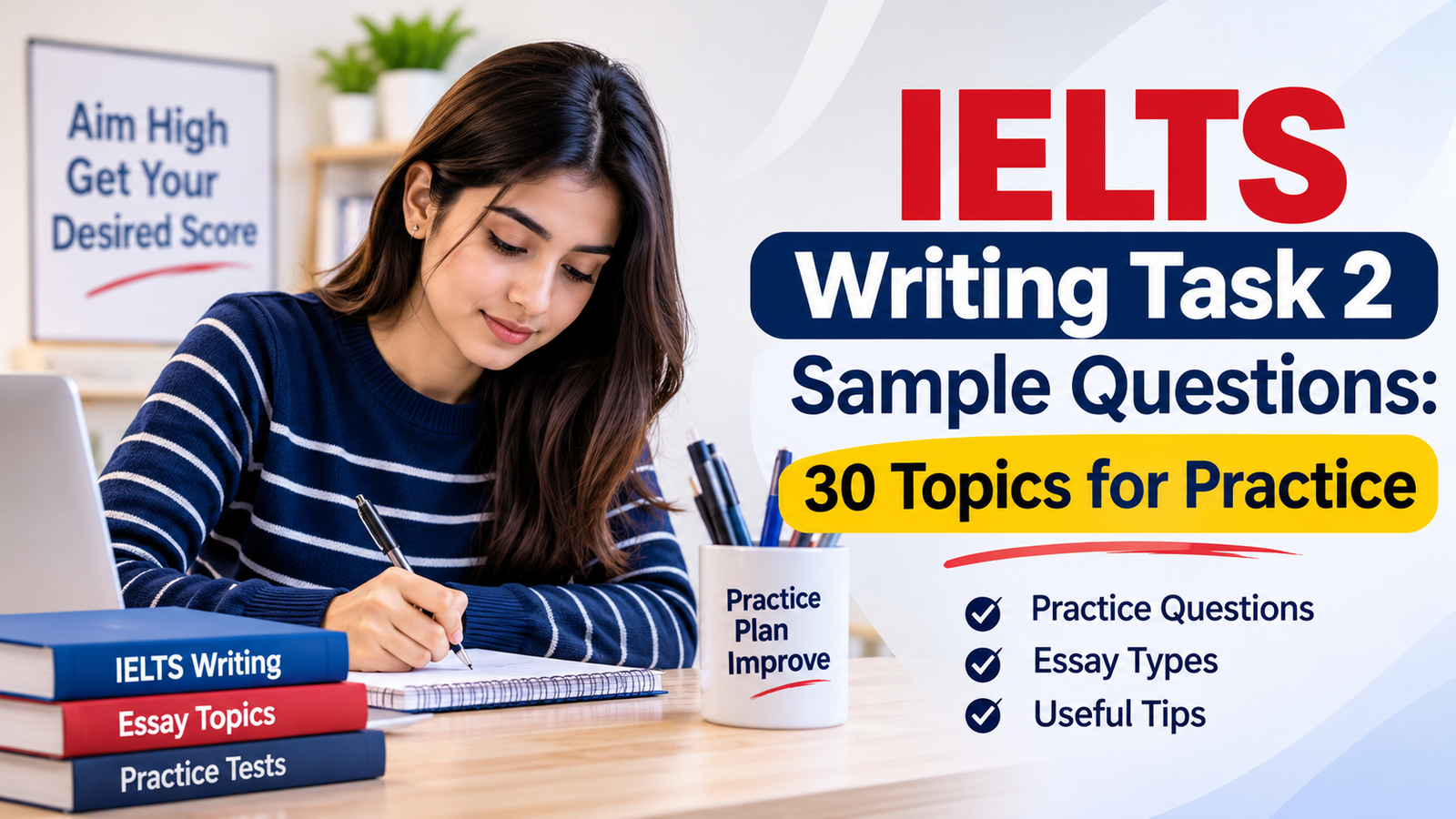
Short answer: IELTS Writing Task 2 is an essay of at least 250 words, written in about 40 minutes, in response to a point of view, problem or question. The 30 practice questions below cover six topic areas and five essay types.
This article gives you 30 original IELTS Writing Task 2 sample questions, grouped by topic and labelled by essay type. Practising with varied questions helps you read prompts carefully and plan quickly. These are practice questions written for study purposes. They are not past exam questions.
What Is IELTS Writing Task 2?
IELTS Writing Task 2 is the second part of the IELTS Writing test. You write an essay of at least 250 words in response to a point of view, argument or problem. The recommended time is about 40 minutes.
The whole Writing test lasts 60 minutes, and Task 2 carries more weight than Task 1. Examiners mark it on four criteria: Task Response, Coherence and Cohesion, Lexical Resource, and Grammatical Range and Accuracy. The Task 2 format is the same for Academic and General Training candidates.
What Are the Main IELTS Writing Task 2 Question Types?
Most prompts fall into five types. Identifying the type first tells you what your essay must do.
| Question type | What the question asks you to do |
|---|---|
| Opinion | Give and support your view. “To what extent do you agree or disagree?” |
| Discussion | Cover both views, usually with your own opinion. “Discuss both views and give your opinion.” |
| Advantages and disadvantages | Explain both sides, sometimes weighing them. “What are the advantages and disadvantages?” |
| Problem and solution | Explain causes or problems, then suggest solutions. |
| Two-part question | Answer two separate questions. “Why is this happening? Is it a positive or negative development?” |
Some prompts blend these features, so always read the final instruction line carefully.
30 IELTS Writing Task 2 Sample Questions for Practice
Each question type appears six times, so you can also practise one type at a time.
Education
- Some people believe university education should be free for all students. To what extent do you agree or disagree? Opinion
- Some people think children learn best in small classes, while others prefer larger groups. Discuss both views and give your opinion. Discussion
- More schools are replacing printed textbooks with tablets. What are the advantages and disadvantages? Advantages and disadvantages
- Many students lose interest in school before they finish. What are the causes, and what can be done? Problem and solution
- Some people think schools should teach life skills such as budgeting and cooking. Why do people hold this view, and is it a good idea? Two-part
Technology
- Many people believe artificial intelligence will make students less able to think for themselves. To what extent do you agree or disagree? Opinion
- Some people prefer to shop online, while others prefer to visit stores. Discuss both views and give your opinion. Discussion
- Smartphones allow people to work and study almost anywhere. What are the advantages and disadvantages? Advantages and disadvantages
- Children now spend more time on screens than playing outdoors. What problems does this cause, and how can they be solved? Problem and solution
- Social media has changed how people get news. Why has this happened, and is it a positive or negative development? Two-part
Environment
- Governments, not individuals, should take responsibility for reducing pollution. To what extent do you agree or disagree? Opinion
- Some people think plastic bags should be banned, while others believe recycling is a better solution. Discuss both views and give your opinion. Discussion
- Tourism is growing in many natural areas. What are the advantages and disadvantages of this trend? Advantages and disadvantages
- Cities are growing quickly, and green space is disappearing. What problems does this cause, and what solutions can you suggest? Problem and solution
- Many people throw away electronic devices after a short time. Why is this happening, and what can be done to reduce it? Two-part
Health
- Some people think the government should pay for all healthcare. To what extent do you agree or disagree? Opinion
- Some believe exercise is the best way to stay healthy, while others think diet matters more. Discuss both views and give your opinion. Discussion
- Some people see a doctor online rather than in person. What are the advantages and disadvantages? Advantages and disadvantages
- Fast food is now cheap and widely available. What problems does this cause, and what can be done? Problem and solution
- People are living longer than before. Why is this happening, and is it a positive or negative development? Two-part
Society and Family
- Parents, rather than schools, should teach children good behaviour. To what extent do you agree or disagree? Opinion
- Some people think young adults should live independently, while others believe they should stay with their parents. Discuss both views and give your opinion. Discussion
- Many people live far from their families because of work or study. What are the advantages and disadvantages? Advantages and disadvantages
- In many cities, people know few of their neighbours. What problems does this cause, and how can communities respond? Problem and solution
- In some places, fewer young people take part in volunteering. Why do you think this is, and what could be done to encourage it? Two-part
Work and Employment
- Employees should be paid according to performance rather than a fixed salary. To what extent do you agree or disagree? Opinion
- Some people prefer a stable job, while others choose to start their own business. Discuss both views and give your opinion. Discussion
- Many companies now allow employees to work from home. What are the advantages and disadvantages? Advantages and disadvantages
- Many graduates struggle to find work related to their degrees. What are the causes, and what solutions can you suggest? Problem and solution
- People change careers more often than in the past. Why is this happening, and is it a positive or negative development? Two-part
How Should You Practise IELTS Writing Task 2 Questions?
Use the same process for every question: read, identify, plan, write, review. Begin untimed, then move to 40 minutes once the process feels natural.
- Understand the question. Underline the topic and the instruction words.
- Identify the essay type. Use the table above to confirm what you must cover.
- Brainstorm ideas. Note two or three reasons or examples for each side or part.
- Plan the essay. Decide your position and the single main idea of each paragraph.
- Write the essay. Paraphrase the question in your introduction, develop one idea per body paragraph with an explained example, and finish with a short conclusion.
- Review your work. Check grammar, vocabulary choices and whether your paragraphs connect logically.
For example, a plan for question 23 could be: position that the advantages slightly outweigh the disadvantages; body paragraph one on career and study opportunities; body paragraph two on weaker daily family support and the cost of travel.
If you would like feedback on your essays, IELTS learning support can help you check your writing against the four marking criteria.
Common Mistakes to Avoid in IELTS Essay Writing
- Going off-topic. Answer the specific question, not the general subject.
- Missing part of the question. Cover both views in a discussion essay and both questions in a two-part essay.
- Repeating ideas. Rewording the same point does not add new content.
- Using memorised answers. Prepared essays rarely fit the exact question and can weaken your Task Response.
- Poor paragraph organisation. Keep one main idea in each paragraph.
- Ignoring grammar and spelling. Frequent errors make your meaning harder to follow.
For a longer list, read our guide to common IELTS writing mistakes.
Frequently Asked Questions
How many words are required in IELTS Writing Task 2?
Candidates must write at least 250 words in IELTS Writing Task 2. Responses shorter than this are penalised, so aim to finish comfortably above the minimum.
How much time should I spend on Task 2?
Spend about 40 minutes on Task 2. The Writing test lasts 60 minutes in total, so this leaves about 20 minutes for Task 1, and Task 2 carries more weight in the Writing score.
What are the common IELTS Writing Task 2 topics?
Education, technology, environment, health, society and family, and work are common IELTS Writing Task 2 topics. Government, media, crime and travel also appear, so practise a wide range of subjects rather than trying to predict one.
Can I use examples in my essay?
Yes. Examples help support your ideas, and they can be general or based on your own experience. Keep them relevant and explain how they support your point, rather than listing facts you cannot verify.
Key Takeaways
- IELTS Writing Task 2 requires at least 250 words in about 40 minutes.
- Five question types appear most often: opinion, discussion, advantages and disadvantages, problem and solution, and two-part.
- Identify the question type before you plan, and answer every part of the prompt.
- Practise across varied topics instead of memorising answers.
Final Thoughts
Steady practice with varied questions builds the habit of reading closely, planning briefly and writing clearly. Choose a few questions each week, write under timed conditions, and review each essay against the question and the four marking criteria.