“Should I take IELTS or TOEFL?” This is one of the most common questions asked by students and professionals across the UAE who are preparing to study abroad, apply for immigration, or simply meet an English proficiency requirement for university or work. With Dubai, Abu Dhabi, and Sharjah home to a huge international student population, choosing the right English test can feel overwhelming, especially when both exams are widely accepted and equally respected around the world.
The truth is, there is no single “easier” test for everyone. IELTS and TOEFL are built differently, and the exam that feels simpler depends heavily on your personal strengths, your target country, and even how comfortable you are with computers versus face-to-face conversation. In this guide, we’ll break down every section of both exams so UAE students can make an informed, confident decision.
Understanding IELTS and TOEFL
What is IELTS? IELTS (International English Language Testing System) is jointly managed by the British Council, IDP, and Cambridge Assessment English. It is available in two formats — Academic and General Training — and is widely used for university admissions, migration, and professional registration.
What is TOEFL? TOEFL (Test of English as a Foreign Language) is administered by ETS (Educational Testing Service) and is primarily an academic English test. It is delivered almost entirely on a computer, including the speaking section.
Why do universities and organizations require these tests? Universities, employers, and immigration authorities use these scores to confirm that a candidate can study, work, or communicate effectively in an English-speaking environment. For UAE students applying abroad, a valid English proficiency test is usually a mandatory part of the application process.
IELTS vs TOEFL: Quick Comparison Table
| Feature | IELTS | TOEFL |
|---|---|---|
| Test Format | Paper-based or computer-based | Computer-based (internet-delivered) |
| Speaking Style | Face-to-face with an examiner | Recorded responses on a computer |
| Writing Style | Task 1 (graph/letter) + Task 2 (essay) | Integrated writing + academic essay |
| Reading Style | Varied question types, general or academic passages | Academic passages only |
| Listening Style | Multiple English accents, everyday and academic contexts | Mostly American academic lectures |
| Score System | Band score, 0–9 | Score range, 0–120 |
| Best Suited For | Students who prefer human interaction | Students comfortable with technology |
| Popular Destinations | UK, Australia, Canada, New Zealand | USA, some Canadian universities |
IELTS vs TOEFL Speaking Section: Which Feels Easier?
This is often where UAE students feel the biggest difference between the two exams.
IELTS Speaking is a face-to-face interview with a certified examiner. It feels more like a natural conversation, with follow-up questions and real human interaction. Many students find this format less intimidating because they can read the examiner’s tone and body language, and the exam feels more like a discussion than a test.
TOEFL Speaking, on the other hand, requires you to speak into a microphone while looking at a computer screen, with your responses recorded and sent for evaluation. There’s no examiner reacting to what you say, which some students find less stressful, while others feel it’s harder to stay natural without a real listener in front of them.
If you’re someone who feels more confident speaking to a person, IELTS Speaking may feel easier. If you prefer structured, private responses without the pressure of eye contact, TOEFL Speaking might suit you better.
IELTS vs TOEFL Listening Comparison
IELTS Listening includes a wide range of English accents — British, Australian, Canadian, and American — along with everyday conversations and academic discussions. The variety helps test real-world listening skills but can also be a challenge for students who are used to only one accent.
TOEFL Listening focuses almost entirely on American English and academic lectures. It places heavy emphasis on note-taking, since you’ll often need to answer questions based on long lecture-style recordings.
UAE students exposed mainly to American media or courses may find TOEFL Listening more familiar. Those who consume a broader mix of English content, including British or Australian shows, may find IELTS Listening more comfortable.
IELTS vs TOEFL Reading Comparison
IELTS Reading uses a variety of question types — matching headings, true/false/not given, multiple choice, and short-answer questions. Academic and General Training versions have different passage styles depending on your purpose (study vs. immigration/work).
TOEFL Reading sticks to academic passages only, generally longer and more textbook-like, with a computer-based multiple-choice format throughout.
Students who enjoy variety and shorter passages often find IELTS Reading more manageable, while those who are strong in academic vocabulary and long-form reading may prefer the consistency of TOEFL Reading.
IELTS vs TOEFL Writing Comparison
IELTS Writing has two tasks: Task 1 asks you to describe a graph, chart, or diagram (Academic) or write a letter (General Training), while Task 2 is a structured essay on a given topic.
TOEFL Writing includes an integrated task, where you read a passage, listen to a lecture, and then write a response combining both, plus an independent academic essay.
IELTS Writing rewards clear structure and the ability to summarize visual data, while TOEFL Writing tests your ability to synthesize information from multiple sources under time pressure. Students confident in interpreting graphs may prefer IELTS, while those strong in listening-to-writing synthesis may find TOEFL more natural.
IELTS vs TOEFL Score Comparison
IELTS uses a band score system from 0 to 9, with most universities requesting a band between 6.0 and 7.5 depending on the program. TOEFL uses a score range from 0 to 120, combining all four sections.
Because the scoring systems are structured differently, it’s important not to compare numbers directly — always check how a specific university or immigration authority converts and evaluates scores. Many institutions publish official conversion charts, but requirements can vary by course, so UAE students should always confirm directly with their target university before choosing a test.
IELTS vs TOEFL: Which Is Easier for UAE Students?
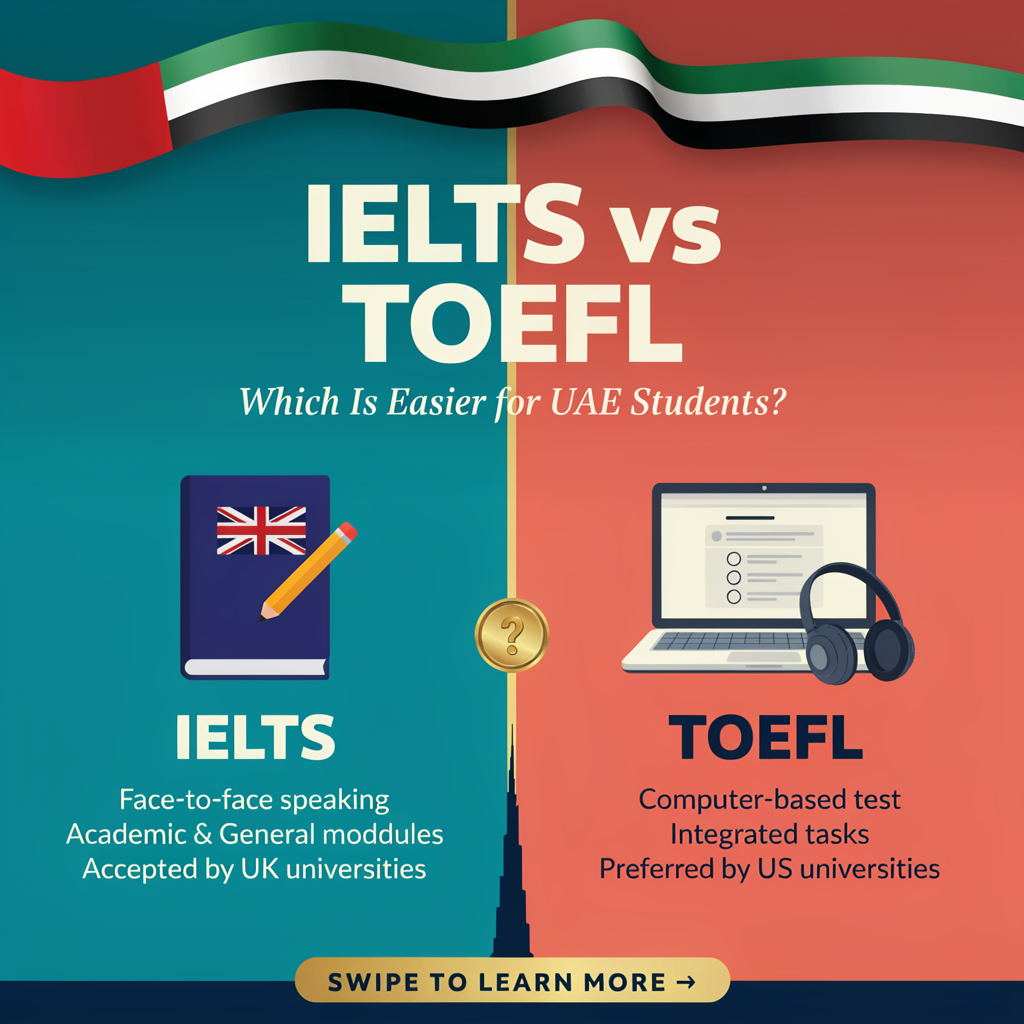
Rather than labeling one test as universally easier, it helps to think about which one matches your personal style.
IELTS may suit students who:
- Prefer speaking with a real person rather than a screen
- Like shorter, varied exam sections
- Are comfortable listening to different English accents
- Need the test for immigration purposes, not just university admission
TOEFL may suit students who:
- Are comfortable working entirely on a computer
- Have strong academic English skills, especially in reading and writing
- Are more familiar with American English
- Are applying mainly to universities in the United States
Many UAE students grow up exposed to a mix of British and American English through school curricula, so the “easier” choice often comes down to which accent and format feels more natural in daily practice.
IELTS or TOEFL for Study Abroad From UAE?
Study in USA TOEFL Preparation has traditionally been the preferred test for American universities, though IELTS acceptance in the USA has grown significantly and is now accepted by thousands of institutions.
Study in Canada IELTS is especially important here, both for university admission and for immigration pathways such as Express Entry, making it a strong choice for UAE students planning to settle in Canada long-term.
Study in UK IELTS remains the dominant test for UK university admissions and visa applications, with strong recognition across nearly all institutions.
Study in Australia IELTS is widely popular for both university admission and skilled migration programs in Australia, though TOEFL is accepted by many universities as well.
Regardless of destination, UAE students should always double-check the specific English proficiency test requirements listed on their target university’s official admissions page, since requirements can differ even between departments at the same institution.
IELTS Preparation UAE and TOEFL Preparation UAE: Why Practice Matters
Whichever test you choose, preparation makes a real difference in your final score. A few practical steps that help UAE students succeed:
- Understand the exam format thoroughly before test day, including timing and question types.
- Improve academic and everyday vocabulary through regular reading in English.
- Practice speaking out loud, ideally with a study partner or tutor, to build fluency and confidence.
- Strengthen writing skills by practicing timed essays and reviewing structure, grammar, and coherence.
- Take mock tests under real exam conditions to build stamina and identify weak areas early.
Consistent practice over several weeks tends to produce far better results than last-minute cramming, regardless of which test you choose.
Conclusion
When it comes to IELTS vs TOEFL, there is no universally easier test — only the test that’s easier for you. IELTS tends to suit students who value human interaction, varied accents, and immigration-focused pathways, while TOEFL suits those who are comfortable with computer-based formats and strong academic English. UAE students should base their decision on their study abroad destination, personal skills, and comfort level with each exam format rather than general opinions about which test is “easier.”
At Jak Global Edu, we help students in the UAE make informed decisions about international education and English proficiency requirements. Our guidance supports learners in choosing the right pathway for their study abroad goals.
Frequently Asked Questions (FAQ)
Is IELTS easier than TOEFL?
Neither test is objectively easier. IELTS may feel simpler for students who prefer face-to-face speaking and varied accents, while TOEFL may feel easier for students comfortable with computer-based academic English.
Which test is better for UAE students?
It depends on your destination and personal strengths. Students applying to UK, Canada, or Australia often lean toward IELTS, while those applying mainly to US universities may prefer TOEFL.
Which exam is better for immigration?
IELTS is generally the preferred test for immigration programs in countries like Canada and Australia, so students with migration goals often choose IELTS.
How long does IELTS or TOEFL preparation take?
Most students spend anywhere from four to twelve weeks preparing, depending on their current English level and target score.