Whether you’re getting ready to study, work, or migrate overseas, you might have looked into all of these questions already: How easy is IELTS? But what is the process to book the exam in Dubai? Or, should I choose the IELTS or TOEFL?
This guide has the answers to all three, and it does so simply and without hyperbole or empty or misleading promises. You’ll discover what IELTS entails, how hard it is for you, how it’s different from TOEFL, and what exactly you need to do to secure a seat in the exam, even before you make it to Dubai and you’ll do it right.
Table of Contents
- What is IELTS?
- How Easy Is IELTS?
- IELTS vs TOEFL
- How to Book IELTS Exam in Dubai
- Why Choose Jak Global Education?
- FAQs
- Conclusion
What is IELTS?
IELTS (International English Language Testing System) is an internationally recognised English test accepted by universities, employers and immigration authorities around the world. It is co-developed by the British Council, IDP: IELTS and Cambridge Assessment English and is based on four skills: Listening, Reading, Writing and Speaking.
There are actually two different versions of the test, and which one you select is important:
IELTS Academic is designed for students applying to universities or professional bodies that require proof of academic-level English. If you’re planning to study abroad, this is almost certainly the version you need.
IELTS General Training is designed for people migrating to English-speaking countries, applying for work, or completing secondary education overseas. It doesn’t test academic English it focuses on everyday and workplace communication instead.
Who should take the IELTS Exam?
Students applying for university in the UK, Australia, Canada or New Zealand.
Skilled migrants applying for visas.
Persons who require an English certificate for work permits
Students applying for professional bodies (nursing, engineering etc) that require proof of English.
Lots of countries accept IELTS, and it’s widely accepted in the UK, Australia, Canada, New Zealand and Ireland. There are several types of visas in the UK where IELTS for UKVI is required for immigration specifically. Choose Our IELTS Course in dubai .
How Easy Is IELTS?
The straight answer is that IELTS is neither an easy nor a difficult exam. It is difficult because it is highly dependent on your level of English, your familiarity with the exam format and your level of preparation.
The IELTS is not a test of intelligence, but of communication ability in a set framework. This means it can be learned. The majority of students who have difficulties are not having a problem with the concepts being tested; they have a problem doing it under time constraints, new kinds of questions or without the benefit of structured practice.
Beginner vs Advanced Students
For beginners (CEFR B1, or Band 4 or lower), IELTS will certainly be really challenging. Words not in your vocabulary make Reading passages difficult to follow; grammatical mistakes in sentences add up under time limits for Writing; and native-speaker Listening audio can be too fast. Most of the beginners find it more beneficial to learn general English fluency before moving on to the IELTS strategy.
IELTS is much easier if you are at an intermediate or high level. The topics – education, health, environment, technology – are subjects that are familiar to most working adults.
opinions on. The challenge shifts from “understanding English” to “performing well within a timed format.”
Factors That Affect Difficulty
- How much you already use English day-to-day
- Your familiarity with question types (matching, True/False/Not Given, sentence completion)
- Your comfort with different English accents in Listening
- Your time management under exam conditions
- Whether you’ve had structured Writing feedback before
IELTS Exam Structure
| Module | Duration | What It Tests |
| Listening | 30 minutes + transfer time | 4 recorded sections, 40 questions |
| Reading | 60 minutes | 3 passages, 40 questions (Academic: journal-style texts; General: workplace/social texts) |
| Writing | 60 minutes | Task 1 (graph/letter) + Task 2 (essay) |
| Speaking | 11–14 minutes | Face-to-face interview in 3 parts |
Tips to Achieve a Higher Band Score
- Take a diagnostic mock test first, so you know your real starting point
- Practise under strict timed conditions, not relaxed reading
- Build topic-based vocabulary instead of memorizing random word lists
- Get your Writing checked by a qualified trainer — self-assessment often misses errors
- Practise Speaking out loud regularly, not just silently in your head
- Do at least two full-length mock exams before your real test date
IELTS vs TOEFL
One of the most common questions students ask is which test is easier. The honest answer: neither is universally easier — they suit different strengths.
IELTS tends to suit you better if you prefer speaking to a live examiner, are comfortable with British or Australian English, or want the option of a paper-based format.
TOEFL tends to suit you better if you’re a confident typist, prefer North American English, and are comfortable recording spoken answers into a microphone rather than speaking face-to-face.
| Feature | IELTS | TOEFL iBT |
| Speaking | Face-to-face with a live examiner | Recorded responses into a microphone |
| Reading | Academic or workplace-based passages | University-level academic texts only |
| Writing | Task 1 (graph/letter) + Task 2 (essay) | Integrated task + independent essay |
| Listening | Mixed British, Australian, American accents | Primarily North American accents |
| Scoring | Band 1–9 (0.5 increments) | 0–120 points |
| Best For | UK, Australia, Canada, NZ; immigration (General Training) | Primarily US universities |
Which One Should You Choose?
If you’re applying to universities in the UK, Australia, Canada, or New Zealand, or you need a General Training version for immigration, IELTS is generally the stronger choice — TOEFL has no immigration-focused equivalent. If you’re applying mainly to US universities and prefer an entirely computer-based format, TOEFL may suit you better. The right test depends on your destination and your personal comfort with each format, not on one exam being inherently easier. If you interested in TOEFL so you can choose TOEFL Preparation Course in Dubai.
How to Book IELTS Exam in Dubai
It’s easy to book IELTS in Dubai as soon as you understand how to.
Step 1: Decide between Academic or General Training depending on which one you need – confirm with your university or immigration agency before booking.
Step 2: Decide on Computer-Delivered or Paper-Based Computer-delivered is typically more available and results are quicker. Paper-based suits all those who prefer handwriting.
In Step :, register with an official provider IELTS in Dubai is offered by British Council and IDP: IELTS. You will register on the official portal, choose the test format, test date, upload your valid passport scan and pay the exam fee online.
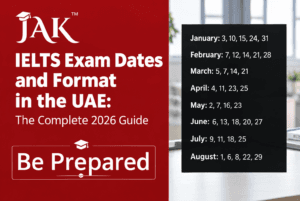
Step 4: Choose your Test Date: Register early, particularly during periods of high bookings (August to October and Jan to March).
Step 5: Take the exam At the exam, show up 30 – 60 minutes before the scheduled time, with the same passport you used to register for the exam.
Step 6: Get your results: Computer delivered results are usually delivered within 3-6 days; paper based up to 13 days.
The preparatory part is half the job of preparing for the exam, the other half is the actual exam. It is at this stage that most students will find it helpful to begin with a structured course first and then make an examination date commitment.
Follow the steps below to apply with Jak Global Education.
For people who are beginning from scratch, or if they are not sure what IELTS test they should take, here is how it works with Jak Global Education:
Step 1 – Reach out to Jak Global Education and let them know that you are interested in IELTS preparation.
Step 2 – Take a FREE consultation or demo class to see how we teach, before committing.
Step 3 – Interview with an IELTS counsellor to determine your current English level and objectives.
Step 4 – Select Academic or General Training, depending on your university/immigration needs.
Step 5 – Choose your favourite batch and timings, depending on your work/study commitments.
Step 6 – Register for your selected course.
Step 7 – Start IELTS preparation with highly trained and qualified trainers.
Step 8 – When you and your trainer are sure you are prepared to take the actual IELTS exam, have assistance in booking an IELTS exam
The sequence is created to ensure that your actual exam booking occurs when your practice scores actually meet the criteria for the target band (not before).
Why Choose Jak Global Education?
Choosing the right institute can significantly affect how many attempts it takes to reach your target IELTS band. At Jak Global Education, we’ve trained more than 15,000 students across Dubai and the UAE, and roughly 25% of Dubai students who opt for structured IELTS coaching choose us specifically.
That trust comes down to a few consistent factors. Our trainers are certified, qualified, and experienced specifically in IELTS preparation — not general English teaching adapted for exam coaching. IELTS has its own scoring criteria and question patterns, and our trainers are trained to teach within that exact framework.
We keep our batch sizes small, so every student gets real individual attention rather than getting lost in a large classroom. Each student’s preparation starts with a diagnostic assessment, so we know exactly which areas need the most focus — whether that’s Writing structure, Speaking fluency, or Reading speed.
Our programs include:
- Regular mock tests under real exam time conditions
- Detailed Writing evaluation from trainers who understand IELTS scoring criteria
- Dedicated Speaking practice that simulates the real face-to-face examiner interaction
- Flexible class schedules for working professionals and full-time students
- Updated study materials reflecting current IELTS question patterns
- Support from your first inquiry through to exam booking
We don’t promise guaranteed band scores — no ethical institute can, since your result depends on your own preparation and performance on the day. What we do provide is a structured, honest assessment of where you stand, and a clear plan to close the gap between your current level and your target score.
Ready to see where you stand? Book a FREE demo class with Jak Global Education today.
[INTERNAL LINK PLACEHOLDER – IELTS Course Page] [INTERNAL LINK PLACEHOLDER – Study Abroad Services]
FAQs
1. Is IELTS hard for beginners? Yes. Beginners typically lack the vocabulary and grammar foundation IELTS assumes, so 3–6 months of general English study before IELTS-specific coaching is usually recommended.
2. How many months does it take to prepare for IELTS? Intermediate students (around Band 5–5.5) often need 6–8 weeks of focused preparation to reach Band 6.5–7. Beginners may need several months longer.
3. Which is easier, IELTS or TOEFL? Neither is universally easier. IELTS suits those who prefer face-to-face speaking and British/Australian English; TOEFL suits confident typists comfortable with North American English.
4. Do I need IELTS Academic or General Training? University applicants need Academic. Immigration, work, or secondary education applicants typically need General Training. Confirm with your specific institution or visa category.
5. How much does IELTS cost in Dubai? Fees are set by British Council and IDP and are revised periodically. Always check current pricing on their official booking portals before registering.
Conclusion
IELTS isn’t a test of natural talent — it’s a structured, learnable exam where consistent preparation makes the real difference. Whether you’re weighing IELTS against TOEFL or figuring out how to book your exam in Dubai, the path forward is the same: understand the format, prepare with honest feedback, and practise under real exam conditions.
Ready to start your IELTS journey? Book a FREE demo class with Jak Global Education today.